

About the author?
Picture this: You're a busy professional with dreams of building wealth, but the mere thought of analysing stock charts makes your head spin. You're not alone. Today, we dive into the story of a software engineer who cracked the code of stock investing while maintaining a work-life balance.
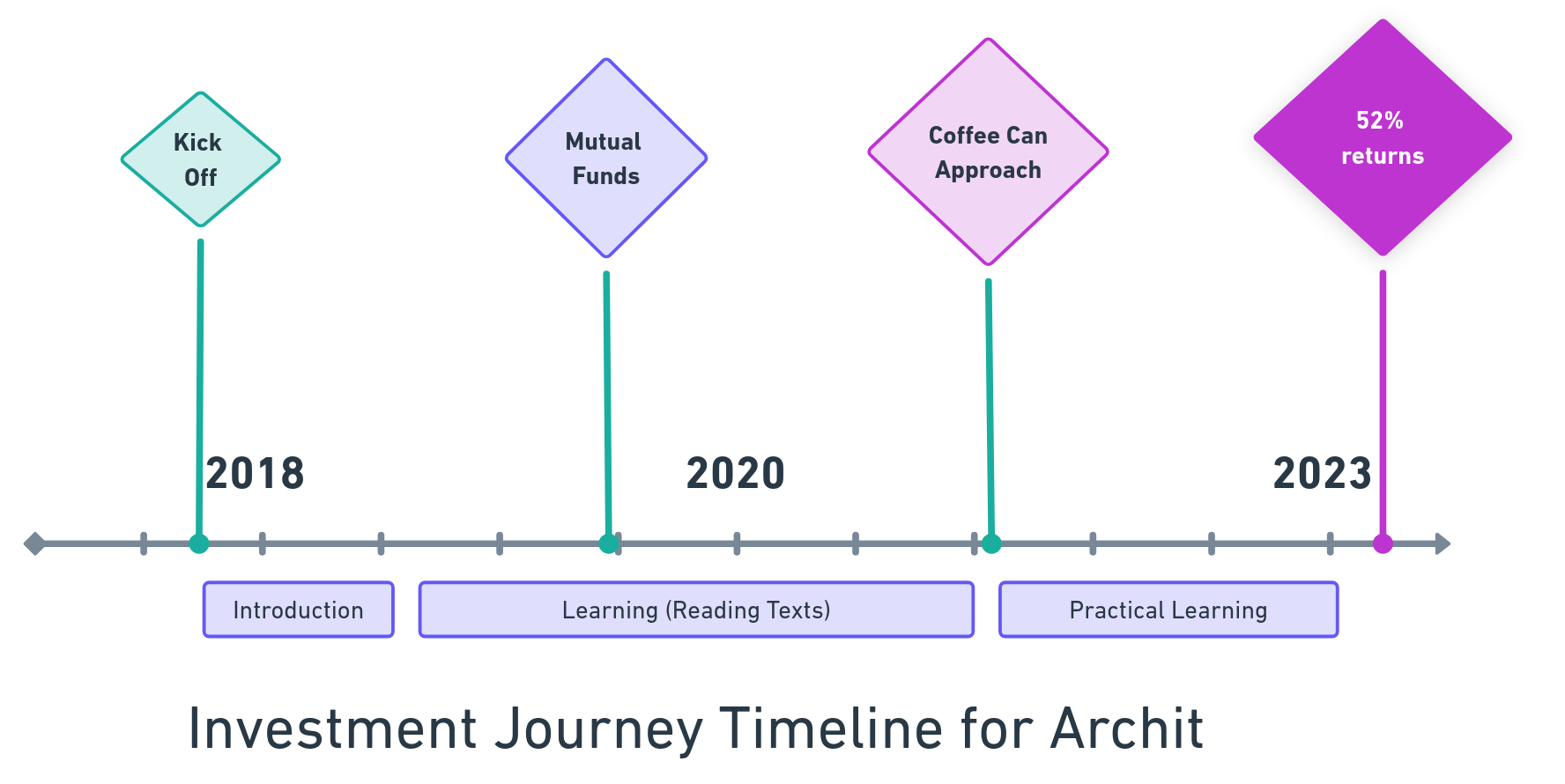
The journey of wealth creation often begins with a spark of inspiration from our childhood. For our protagonist, a software engineer named Archit Latkar, whose portfolio achieved an impressive 56% return in just 18 months, that spark came from watching his parents track the stock market and manage their investments in mutual funds and provident funds.
The Early Years: Seeds of Financial Curiosity
Picture a young college student, fresh-faced and eager, watching his parents pore over stock charts and mutual fund reports. This early exposure planted the seeds of financial curiosity in our protagonist's mind, though he couldn't have known then how it would shape his future.
Our engineer dove into his studies and dipped his toes into the world of financial literature. "Rich Dad, Poor Dad" and "The Richest Man in Babylon" opened his eyes to the allure of passive income. But with a packed schedule of coursework and skill development, mastering the intricacies of stock trading seemed like a distant dream.
The Psychological Challenge: Overwhelm
Imagine being surrounded by a cacophony of financial advice:
- Friends boasting about intraday trading wins
- Classmates exploring the complexities of futures and options
- The ever-present buzz of cryptocurrency and NFT enthusiasts
Each claimed their path was the "right way" to financial freedom. For our protagonist, this information overload led to a crucial realisation: trying to do everything would lead to accomplishing nothing.
The First Step: Embracing Imperfection
Rather than succumbing to analysis paralysis, our engineer made a pivotal decision – he started small with an index fund. This choice, while conservative, taught him valuable lessons:
1. The power of starting: Even a small step forward is progress
2. Market behaviour insights: Witnessing firsthand how indices move over time
3. The importance of patience: Understanding that wealth-building is a marathon, not a sprint
The Working Professional's Epiphany
As our protagonist entered the workforce, he faced a new challenge: balancing career growth with financial aspirations. This led to a crucial psychological breakthrough – the creation of a clear priority matrix:
1. Excel as a software engineer
2. Maintain personal time for hobbies and growth
3. Build long-term wealth through investing
This mental framework became the foundation for all future financial decisions, allowing him to pursue investing without sacrificing his primary career or personal life.
The Coffee Can Revolution
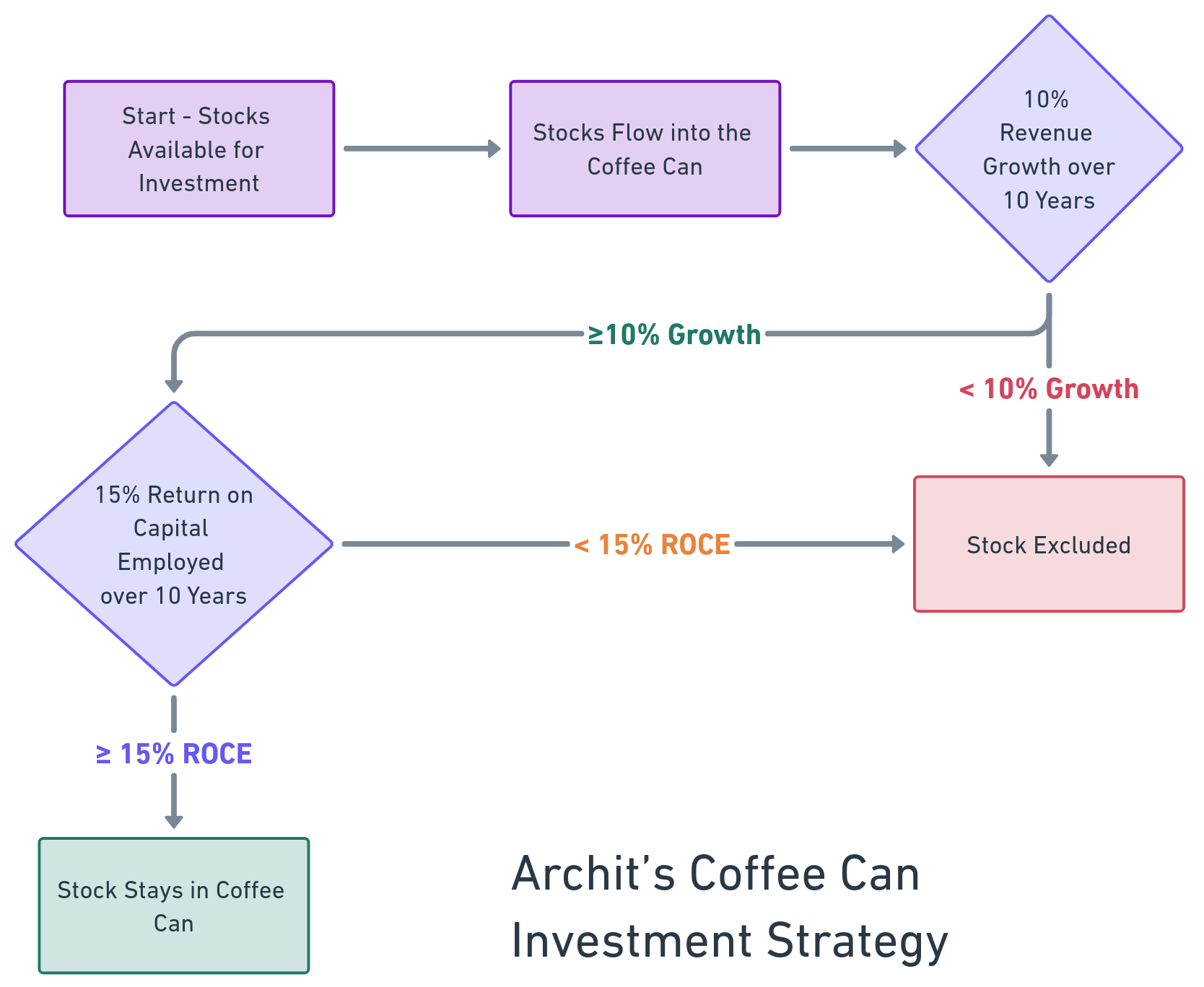
The game-changer came from Saurabh Mukherjea's book on Coffee Can Investing. This approach resonated deeply with our engineer's analytical mind, offering a systematic way to evaluate stocks using just two criteria:
- 10% revenue growth over 10 years
- 15% return on capital employed over 10 years
Why these 2 metrics?
It is quite easy to understand these two parameters -
The nominal GDP growth rate in India has consistently been around 12-13 %, except for the COVID years. Hence any company should be able to at least keep pace with this growth rate in their revenue. Hence the metric of Revenue Growth of at least 10 percent.
The second metric - Return on Capital Employed → measures the efficiency with which a company employs the capital it has. Capital is employed to increase the income flow for the company. An efficiency of around 15 % is a good benchmark.
An important part of both these metrics is the period for which we are seeing this data - 10 years or more. This is because the time frame of 10 years gives us much more insight into the company's health as compared to something like 2-3 years.
Also, notice that we should see the metrics being met every single year rather than taking an average. This helps us in finding those companies that have been doing well consistently for many years over those which were benefited from some sudden growth factor and subsequently couldn’t keep up the same growth.
The Psychological Shift: This simple framework cuts through the noise, providing a clear path forward and alleviating the mental burden of endless analysis.
“To consistently generate healthy returns from equity investing, one has to invest in high-quality companies and then sit tight for long without losing sleep about where the share price is going”
Building the Portfolio: An Engineer's Approach
Our protagonist's technical background influenced his portfolio construction in fascinating ways:
1. Cross-industry distribution: Applying the concept of load balancing from software engineering to financial diversification
2. B2B vs. B2C balance: Understanding the different growth potentials and risks, much like evaluating enterprise vs. consumer software products
3. Strategic monopoly plays: Identifying companies with strong market positions, akin to selecting dominant technologies in software development
The Experimental Edge
Even within his structured approach, our engineer maintained room for calculated risks. He took "wild shots" at companies like Mankind Pharma and Vodafone-Idea, demonstrating the psychological importance of balancing a core strategy with controlled experimentation.
The 80-20 Principle in Action
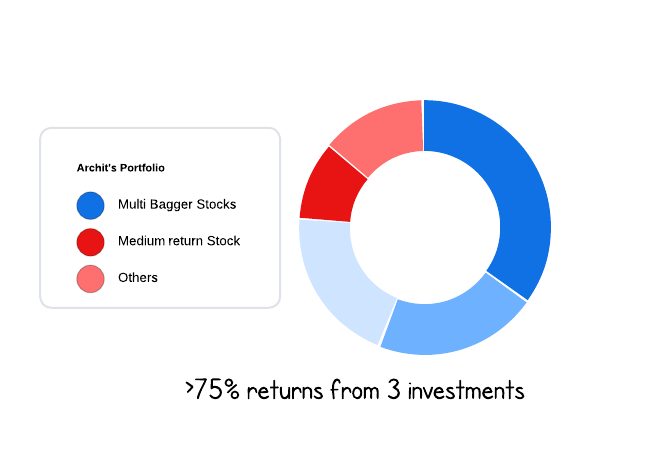
Our protagonist's portfolio performance beautifully illustrated the Pareto principle. With returns ranging from -35% to an impressive 200%, three stocks generated most of his 56% overall return in just 1.5 years.
Key Psychological Insight: Understanding that not every investment will be a winner allowed our engineer to stay calm during market fluctuations, focusing on the overall portfolio performance rather than individual stock movements.
Lessons Learned: The Mental Models of Success
1. Patience as a Superpower: The ability to sit tight during market fluctuations, understanding that time is an investor's best friend
2. Fiscal Discipline: Developing a systematic approach to saving before investing, ensuring financial stability
3. Action Over Analysis: Overcoming analysis paralysis by focusing on key metrics rather than getting lost in endless data
4. Embracing Imperfection: Accepting that not every stock will perform well, but trusting in the overall strategy
Looking Forward
Our software engineer's journey from a college student overwhelmed by options to an investor with a 56% return portfolio in 1.5 years illustrates the power of psychological transformation in financial success. He continues to balance his thriving engineering career with his growing investment portfolio, proving that you don't need to be a full-time trader to achieve impressive returns.
---
Remember, this isn't just a story about stock market success – it's a testament to how the right mindset can transform overwhelming challenges into systematic achievements. By focusing on clear priorities, embracing simplicity, and maintaining a long-term perspective, our protagonist found a way to build wealth without sacrificing his primary passions and goals.
Thank You
A heartfelt thank you to Archit Latkar, a software engineer whose candid sharing of his investment journey has provided valuable insights into the psychology of stock market investing. His story demonstrates that success in investing isn't about becoming a market expert, but rather about developing the right mindset and systematic approach while staying true to one's priorities.
Share Your Story!
Has this story resonated with you? Do you have your own journey of discovering and mastering an X - whether it's investing, coding, or any other pursuit? We'd love to feature your story in DoX.
Why Share Your Story?
Inspire others on similar journeys
Build your brand
Connect with like-minded individuals
Earn rewards for your contributions
Join our community of storytellers by sharing your experiences. It only takes 30 minutes every 2-3 weeks to contribute, and your story could be the inspiration someone else needs to start their journey.
Ready to Share?
Share your experiences and get published on our feed! It only takes 30 minutes every 2-3 weeks to contribute. Your story could be the spark that ignites someone else's financial transformation. To get started, visit here.
Nice work
Good article
The info provided is indeed useful